Nordic vs Scandinavian Art: What's Actually the Difference?
June 8, 2026
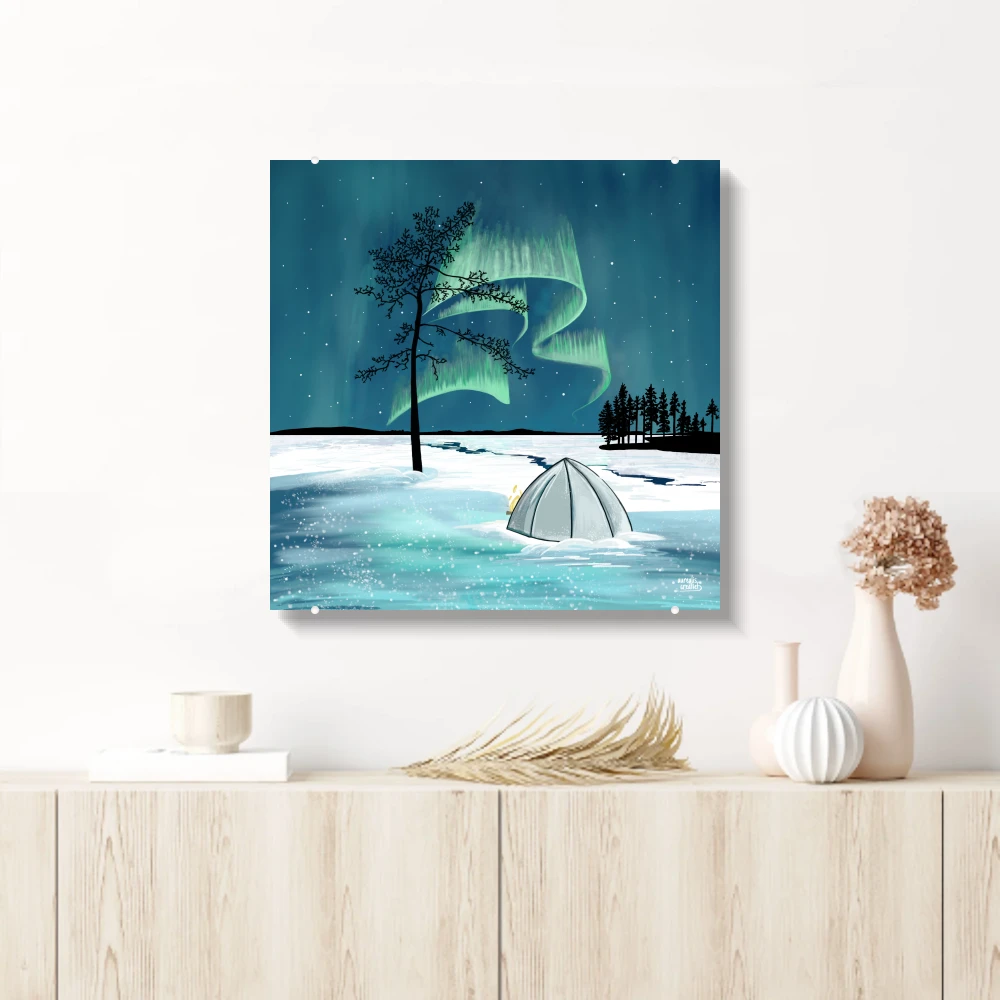
If you have ever shopped for art for your home and switched between the search terms "Scandinavian wall art" and "Nordic wall art", you have probably noticed something strange. The two queries pull up overlapping but slightly different results. One gives you minimalist line drawings, soft typography, abstract geometric shapes. The other gives you landscapes, aurora skies, reindeer in winter light.
The terms get used interchangeably, both in marketing and in casual conversation. They are not the same. They overlap, but they describe different things and when you are choosing a piece of art that will hang on your wall for the next ten years, the difference matters.
I work in this space every day. My own work is Nordic, not Scandinavian, and I have spent enough time explaining the difference to clients and hotel partners that I thought it was worth writing down properly.
Where the confusion comes from
Geographically, the two regions overlap but are not identical. Scandinavia, in the strict sense, is three countries: Norway, Sweden, and Denmark. The Nordic countries are the larger group: those three plus Finland and Iceland, along with the autonomous territories of Greenland, the Faroe Islands and Åland. Running across the north of Norway, Sweden and Finland, and into Russia, is Sápmi, the homeland of the Sámi people. Part of it is what many people know as Lapland.
So all Scandinavian countries are Nordic, but not all Nordic countries are Scandinavian. Finland and Iceland in particular sit firmly in the Nordic category, outside of Scandinavia.
The confusion gets worse in marketing. Travel companies, interior brands, and lifestyle magazines have spent decades using the two words interchangeably, mostly because "Scandinavian" sounds more familiar to international audiences. The result is a blurred vocabulary that flattens real cultural and aesthetic differences.
Scandinavian: a smaller, design-led world
When most people say "Scandinavian", what they actually have in mind is the Scandinavian design tradition that emerged in the 1950s: Wegner chairs, Jacobsen lamps, the clean lines and pale woods of mid-century Nordic furniture. (Yes, Nordic: Alvar Aalto was Finnish, and his work is foundational here.)
Out of that tradition came an aesthetic vocabulary that is now instantly recognisable: function over ornament, light wood, off-white, soft greys, an emphasis on natural light, restraint, hygge.
When that vocabulary moved onto the walls, Scandinavian wall art came to mean a fairly specific thing: minimalist line drawings, geometric and abstract compositions, pale palettes of sand and oat and dusty pink and soft blue-grey, typography prints with quiet phrases, stylised illustrations of houses or plants or faces. A flat, graphic visual language.
It is, in essence, design applied to art. The point is the aesthetic conversation with the rest of the room. The art is part of the design system.
Nordic: a larger, nature-led world
"Nordic" pulls in a different direction. It is geographically broader, and it carries cultural and emotional weight that "Scandinavian design" does not, because it includes the parts of the North that are most defined by their landscape and their climate. Finnish Lapland. Icelandic glaciers. Greenlandic ice. The Sámi territories. The Arctic.
When Nordic shows up in art, it is rarely about minimalist style. It is about place. The wilderness, the weather, the light, the wildlife.
Nordic wall art often shares the cool, restrained palette of Scandinavian art, but applies it to real subject matter rather than abstraction: a specific landscape, a specific season, a specific kind of light. It tends to be illustrative or painterly rather than graphic. I go deeper into what defines the style in What is Nordic nature wall art?
If Scandinavian wall art is design applied to art, Nordic wall art is landscape captured as art. The point is the place itself.
How they show up on the wall
Both sit comfortably in the same kind of interior: cool tones, restraint, calm composition. The difference is what they do once they are hanging. Scandinavian wall art works as a graphic element that continues the design of the room. Nordic wall art works as a window that opens the wall onto another place.
Which one suits which room is a question of its own, so I wrote a separate room-by-room guide on how they show up on the wall.
Which one is right for you?
If you are decorating with Scandinavian design in mind and you want art that continues that aesthetic conversation, look for Scandinavian wall art. Line work, soft abstractions, restrained typography.
If you want art that brings the actual North into your home you are looking for Nordic wall art. Specifically, what I would call Nordic nature wall art: Go for the landscape, the light, the weather, the wildlife!
You do not have to choose. Many of the homes I work with have both: a Scandinavian print or two for graphic balance, and a Nordic landscape piece somewhere as the room's window onto the wider world.
Where my own work fits
My work sits firmly in the Nordic, nature-led tradition. I spent six winters in Finnish Lapland, and the Lapland 8 Seasons collection came directly out of that experience. Finland is Nordic, not strictly Scandinavian, and the collection follows the eight Sámi seasons rather than the four most of us grew up with.
The Arctic Adventures and Into the Nordic Wilderness collections extend that further into Nordic landscape and wildlife. None of it is Scandinavian in the design-tradition sense. All of it is Nordic in the geographic and cultural sense.
If that is the kind of art you have been quietly looking for, you have probably found it.
If you’d like to stay updated on new work, a new season, or a story about one of my pieces. I’ll send you a newsletter every two months.
Sign up for Letters from the Studio
Els