
The size of your wall art
How to choose size and placement
Artfully Explained
What size wall art should you choose, and where should you hang it?
When we chose our fireplace, I stood in the living room with a tape measure. How big would the opening in the existing stone surround be? We went for a generous fireplace insert, because that looked best in proportion. A small one would never have shown the flames in that big stone surround as beautifully as a larger size. With art, we rarely think it through like that. We choose the image, and only once it is on the wall do we see that it is too small, or that something is reflected in it.
This page helps you see that in advance. With a few simple rules of thumb, and with examples from my own home and from the lodge in Lapland where my work has hung for years.
Eye-catcher
Where should the eye go in your interior?
The free wall you have to work with decides a lot. But something else matters even more. If you have a whole wall free, should you simply go for a very large size? No. First think about the role your wall art should play. Should the piece be the eye-catcher, or do you want to draw attention somewhere else?
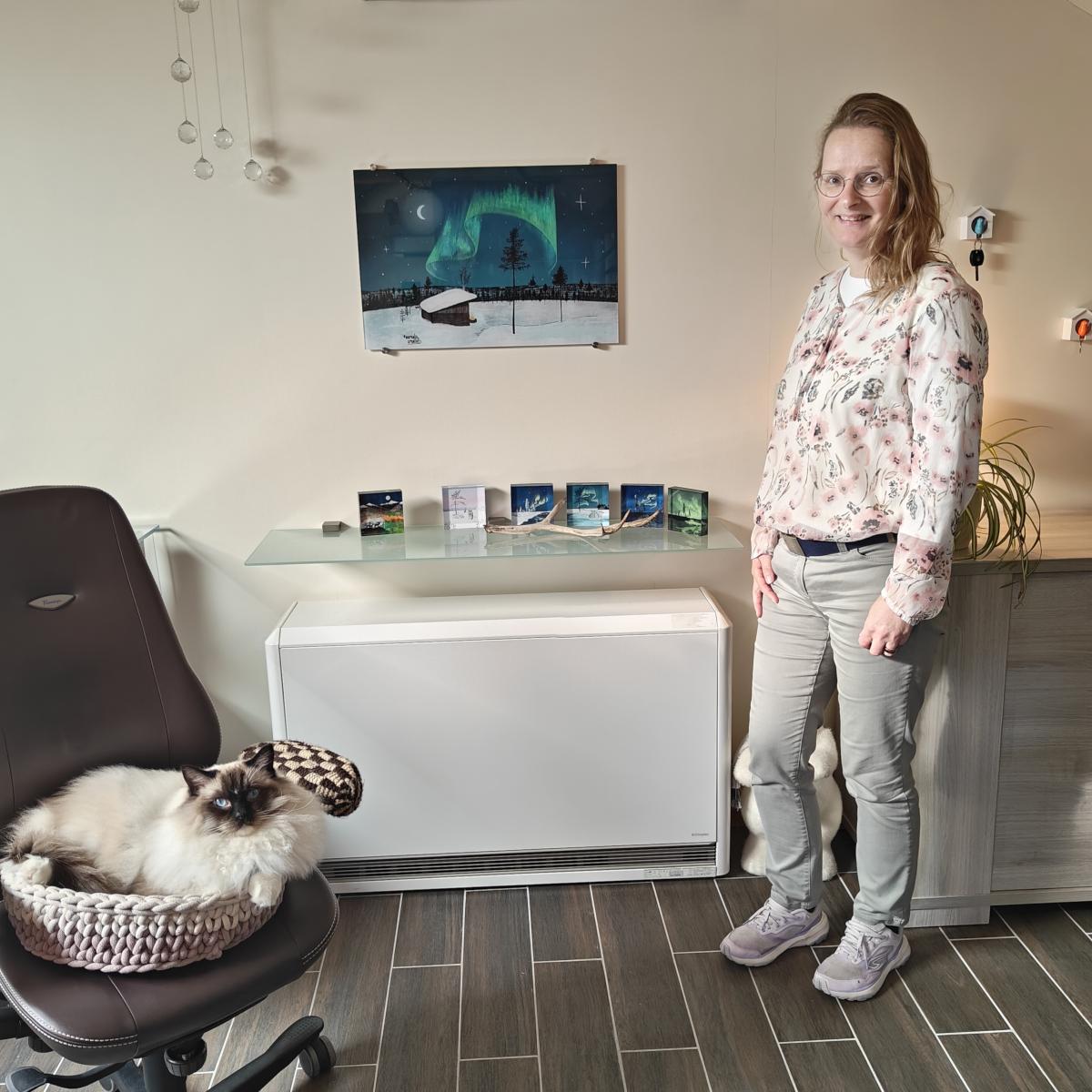
In my studio, a 60 × 40 cm (24 × 16 in) acrylic glass piece hangs above a large radiator. It draws all the attention as you walk in, and you hardly notice the radiator below. On the glass shelf in between stand a few art blocks, which I swap around. That way the corner changes with the seasons, without me drilling a single extra hole.
In our bedroom, a wall-filling print of the northern lights above our yellow house in Lapland hangs over the bed. Walk in, and you see nothing else. But once we are in bed, the birch outside the window takes over: we see it change colour every day, every season. Close the curtains, and we are back in the Far North.
- Should the piece draw the eye? Go large, or choose a series.
- Is there already something beautiful to see, a garden, a forest, a window with a view? Then the piece can be smaller, so the two do not compete for attention.
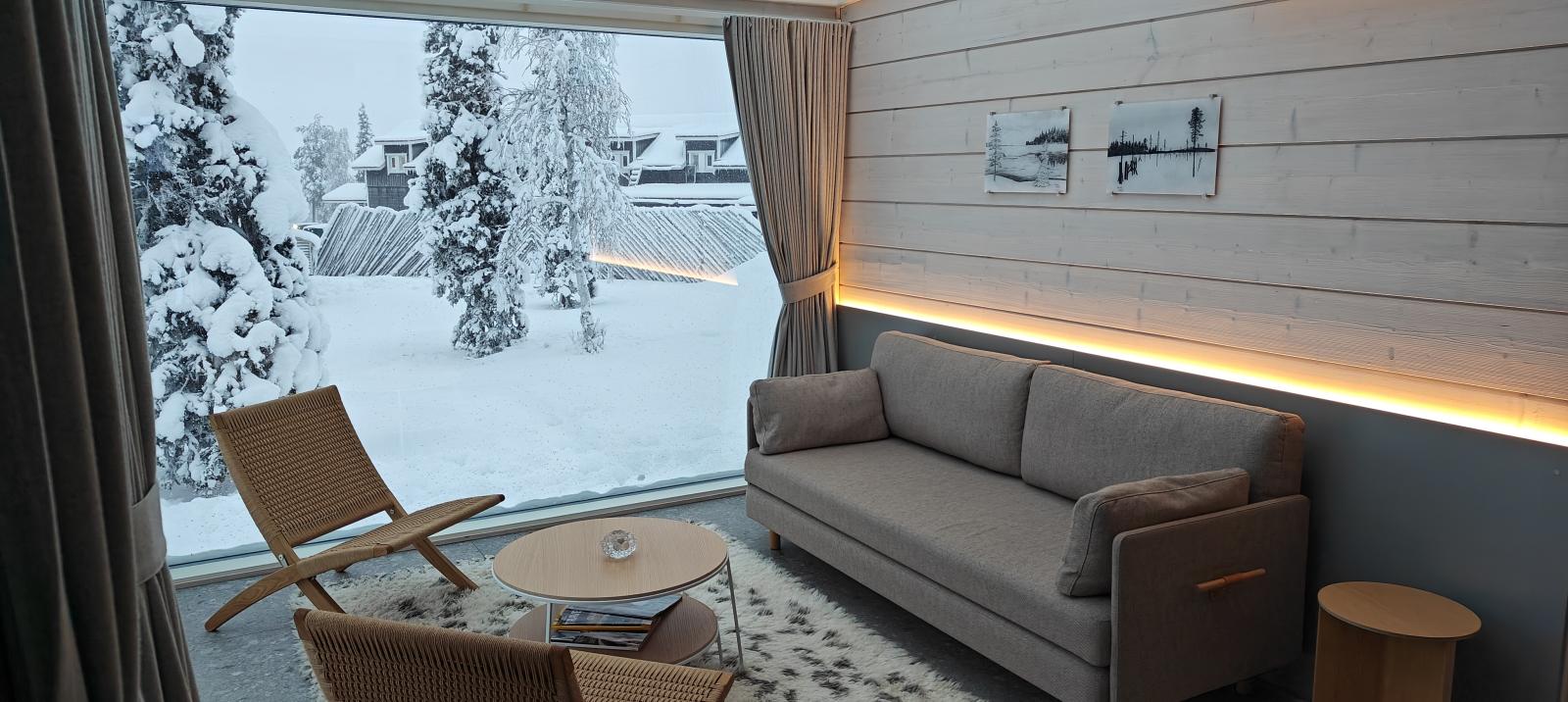
It works this way in the sky view cabins at Northern Lights Ranch. As you come in, you see the artworks straight away, directly opposite the door. Once inside, you turn around and the view through the large windows takes over. When it gets dark, the artworks get all the attention again, until the northern lights appear and the glass roof takes the lead once more.
Angle, light and reflections
Viewing angle, light and reflections
Whether a glossy piece reflects depends on where you are looking from. A piece on a side wall can look perfect from the sofa, and show the window from another angle. If you sit lower, on a sofa or in bed, the light from the ceiling lamp often falls right onto the piece.
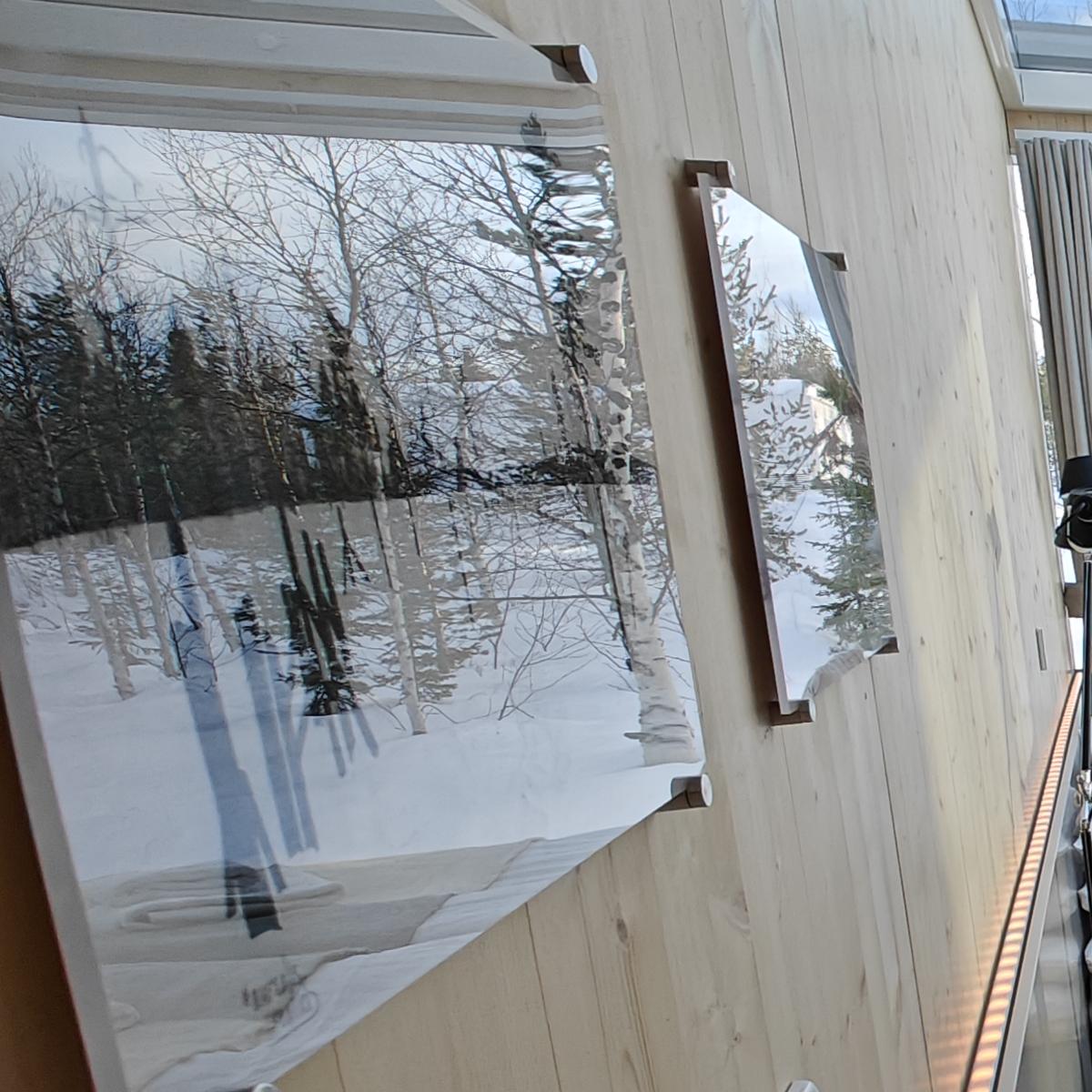
A small picture light just above the piece solves a lot: it shows the work off without bouncing off the gloss. But who has one at home? I do not. A floor lamp angled at the wall already makes a big difference.
How acrylic glass and metal behave with light, including the mirror test and the matte finish available on request, is covered in acrylic glass, metal plate or art block.
How big should your wall art be? A few rules of thumb
Above a sofa, bed or sideboard
A common rule of thumb: the piece, or the group of pieces, is about two thirds the width of the furniture below. Above a 200 cm (79 in) sofa, that is around 130 cm (51 in). None of the standard sizes in my shop gets there on its own, and I would rather say so honestly.
There are three solutions:
- A series of two or three pieces that fill the width together
- A large custom size (see below)
- A smaller piece, cleverly framed by what is already there
cleverly framed
Small works too, if the rest of the room joins in
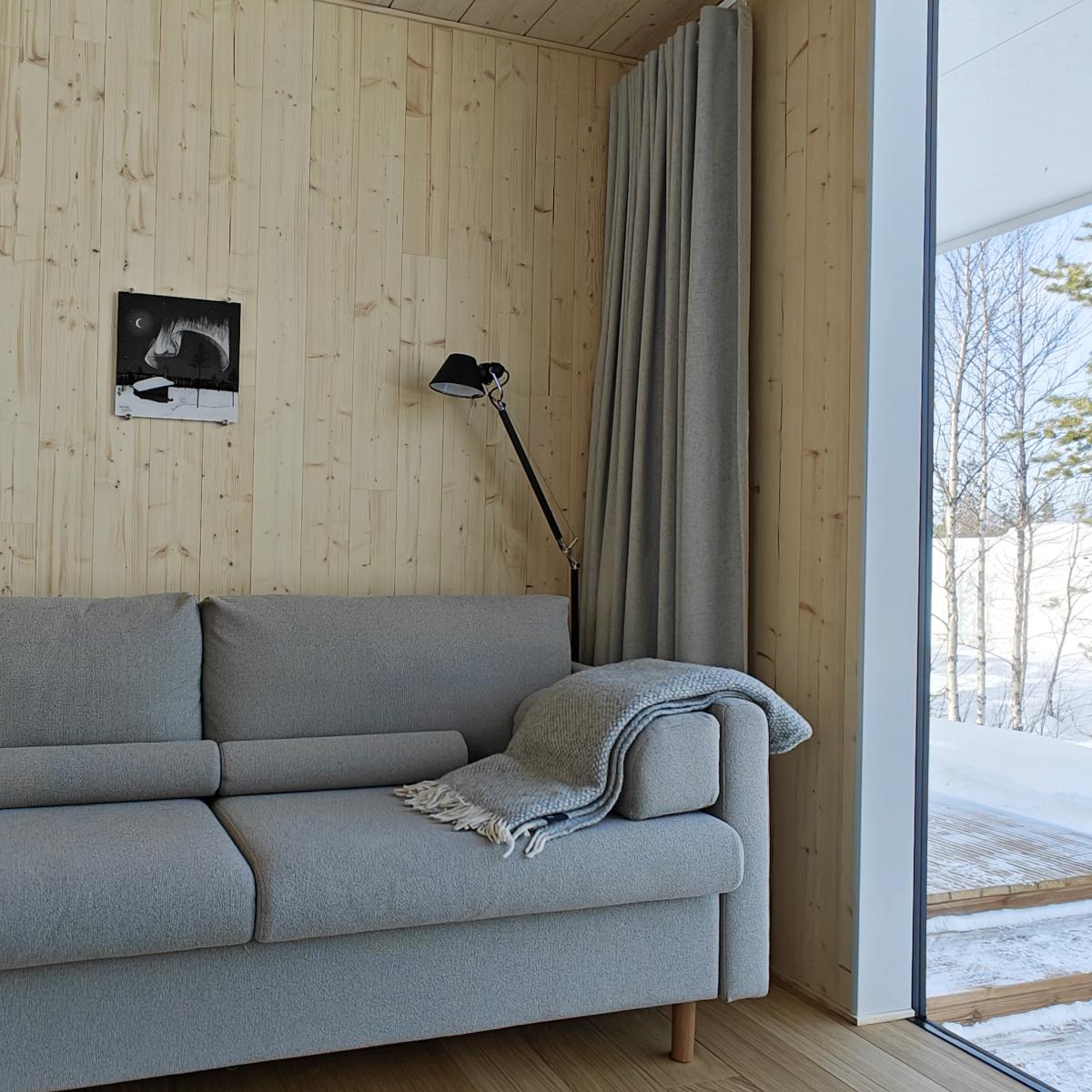
Above the sofa in one of the cabins hangs a piece of 30 × 30 cm (12 × 12 in). By the rule of thumb, far too small. And yet it works: a floor lamp beside it and the curtain drawn up to the side wall fill the wall, and the small piece holds its own. So the size depends not only on the wall, but also on what is already around it.
The right height for your artwork
- Centre at eye level: around 150 to 160 cm (59 to 63 in) from the floor. Museums often hang their works a little lower, but for tall people that is just too low: I am 1.78 m and always end up looking down at them slightly.
- Above a sofa: the bottom of the piece about 20 to 30 cm (8 to 12 in) above the back of the sofa. From the sofa you look up at it slightly, and from the room it hangs at eye level.
- Above a sideboard or cabinet: also 20 to 30 cm between the furniture and the piece. Go higher than 40 cm (16 in) and the piece floats loose on the wall. If something stands on the cabinet, a lamp or a few art blocks, keep that space clear, or the bottom of the piece disappears behind whatever is in front of it.
- Above a tall cabinet: hang the piece in the middle of the space between the cabinet and the ceiling.
- Above a bed: simply hang it at eye level for someone standing. Once you are lying in bed, you look elsewhere anyway.
- In a seating area or dining room it can hang a little lower, as you usually look at it sitting down.
Steal the show
Look at where the action is in the image
With my northern lights artworks, and in illustrations where the best part happens in the sky, such as a midnight sun, hang the piece about 10 cm (4 in) lower than the heights above. That way the sky sits at eye level.
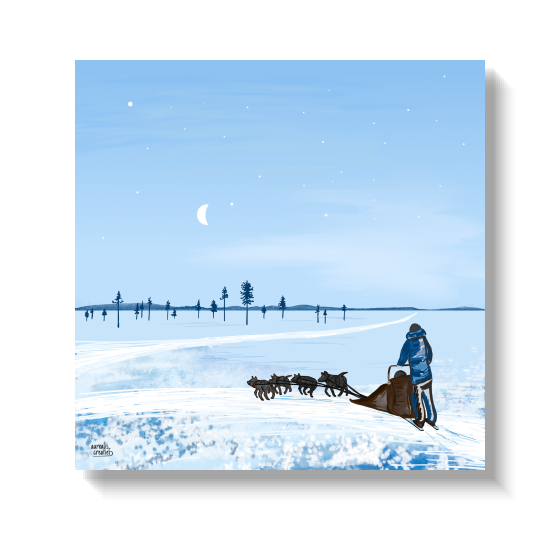
With my Arctic Adventures collection, the opposite applies: there the action happens on the ground, with the huskies or the snowmobile, so hang the piece 5 to 10 cm (2 to 4 in) higher. At least, as long as the sky does not steal the show.
Calm & Rhythm
Two or three artworks as a series
A series brings both calm and rhythm. Two pieces of 40 × 30 cm (16 × 12 in) side by side fill a wall the way one large piece would.
- Treat the series as one unit: apply the two-thirds rule to the whole group, not to each piece.
- Leave 5 to 10 cm (2 to 4 in) between the pieces. More, and they drift apart; less, and they stick together.
- Choose pieces that belong together: from the same collection, or with the same light.
- Try it out first. Cut paper or card to the size of your pieces and stick it to the wall with masking tape. Leave it up for a day and look at it from the places where you usually sit. Only then pick up the drill.
In a long hallway, a series works in yet another way. In my studio, two pieces hang in the passage to the second room. They draw you inside, as it were. Hang several pieces one after another in a hallway, and they lead you through it.
Custom sizes
Larger than standard: custom sizes
Do you really want to fill a wall with a single piece? Then I will make it to size. On acrylic glass, that goes up to 120 × 80 cm (47 × 31 in) in 3:2. For square pieces, 60 × 60 cm (24 × 24 in) is the largest size in my shop; larger is possible on request. For truly large sizes, we choose a different, sturdier backing together, and shipping needs extra care. Tell me how wide your furniture and your wall are, and I will help you find the size and backing that fit best.
Choosing for a hotel, a lodge or an office? I can make a test print. More on that in acrylic glass, metal plate or art block.
Frequently asked questions
Can a small artwork go above a large sofa?
Yes, if the rest of the wall joins in. A floor lamp, a plant or a curtain drawn up to the side wall fills the space around a small piece. If you want the piece to carry the wall on its own, choose a larger size or a series.
How big should art above a sofa be?
As a rule of thumb, about two thirds of the width of the sofa. For a 200 cm (79 in) sofa, that is around 130 cm (51 in): one large custom piece, or a series of two or three pieces hung as one unit. A smaller piece can work too, if a lamp or curtain fills the rest of the wall.
How high should you hang an artwork?
With the centre at eye level, around 150 to 160 cm (59 to 63 in) from the floor. Above a sofa or sideboard, leave 20 to 30 cm (8 to 12 in) between the furniture and the bottom of the piece.
How much space should you leave between two artworks?
Usually 5 to 10 cm (2 to 4 in). That way the pieces read as one series, without sticking together.
Luxury Interior Art · wall art
Find your piece
Every collection is in the shop. Not sure about the size? Send me a message with the width of your wall and your furniture, and I will think it through with you.
contact
Let's bring your space to life
Whether it's a custom project for your hotel, a question about a piece of work, or just to say hello: I'll respond personally, usually within one business day.
Aurealis CreatiefEls Bancken
Boudewijnlaan 13590 DiepenbeekBelgium